Chapter 4
Chapter 4: A Finite Deformable Boundary Cosmology
Chapter 4 figure anchors
Abstract
This chapter defines a finite deformable boundary cosmology. In this model, local gravity is preserved as a General-Relativity-compatible limit, while cosmological observations are interpreted through separate internal registers rather than a single universal expansion scale. The universe is treated as a bounded deformable event-domain characterized by an interior stable region, an approach regime, a projection boundary, and a compressed projection side, alongside local deformation wells and matter-void foam.
Observed redshift is maintained as the direct observable but is expressed as accumulated path response, \(A = \ln(1 + z)\). The response law \(G(d) = g_0/(1 + d/d_b)\) integrates to \(A(d) = g_0 d_b \ln(1 + d/d_b)\), establishing a non-expansion path coordinate \(d(z)\). Observable distances are subsequently split into radial, transverse, luminosity, angular-size, time-stretch, acoustic, morphology, gravity, and compactness registers.
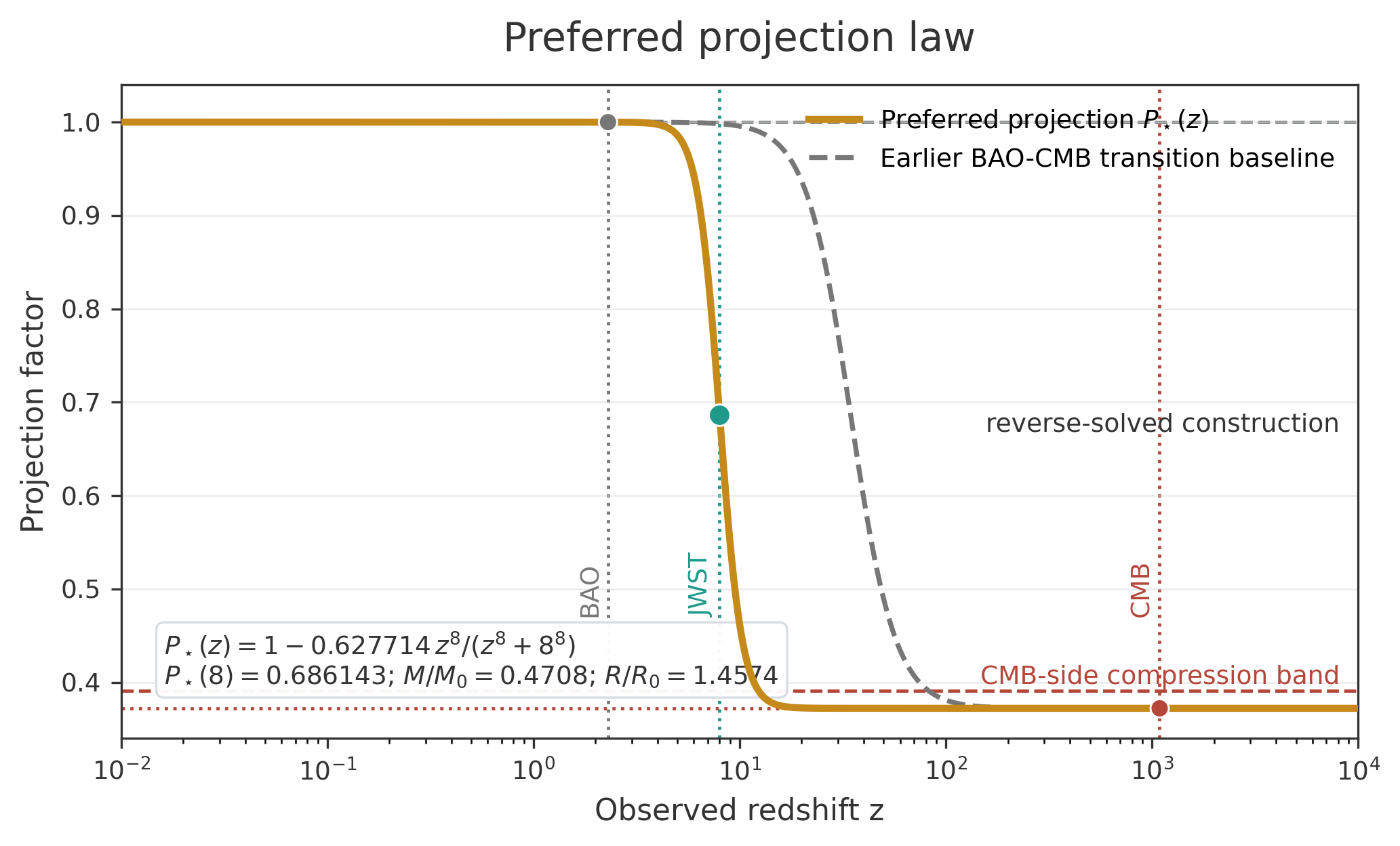
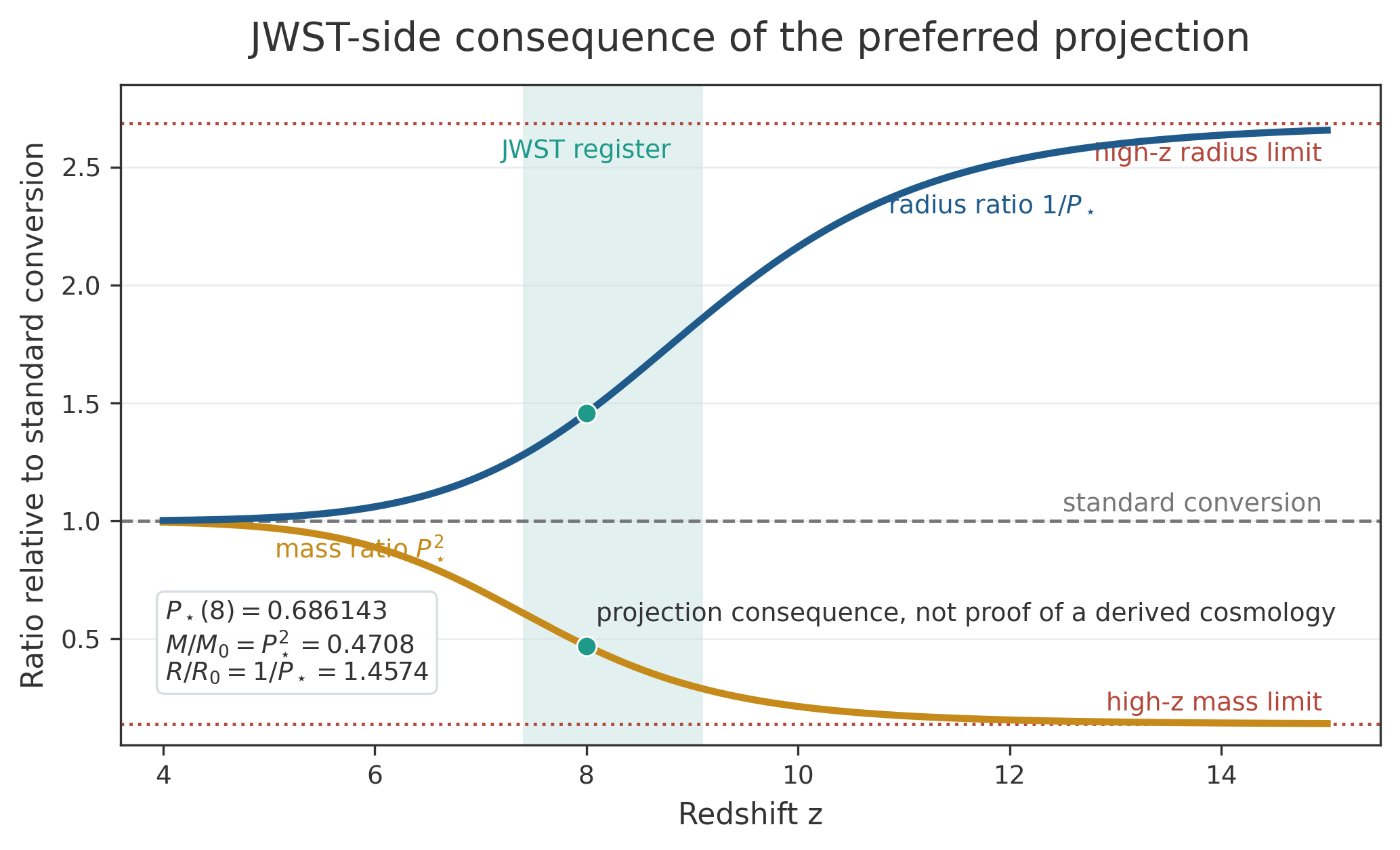
The preferred projection law, \(P_{\star}(z) = 1 - 0.627714 z^8/(z^8 + 8^8)\), is derived from three primary observational anchors: the preservation of the BAO range, the mass-size shifts observed in JWST galaxies, and the compressed projection band of the CMB. This resulting construction leaves the BAO range nearly unchanged, shifts the inferred properties of \(z \approx 8\) galaxies, and approaches the same CMB-side compression identified by the BAO-CMB shared-ruler failure. The completed model is a finite-register cosmology: local GR behavior remains intact, path-response redshift governs the interior, a projection shoulder exists in the high-redshift regime, and a compressed acoustic projection register defines the CMB boundary.
The register-scaling parameters \(K_D \sim 1/2\), \(K_X \sim 1\), and \(K_\eta \sim 2/3\) provide a compact diagnostic test of whether the finite-register sectors behave as unrelated adjustments or as linked scaling regimes of one deformable geometry. They are not treated as derived constants. The compactness test remains inconclusive, so the full cosmology carries \(K_u=1/3\) only as a trial compactness parameter, with \(K_u\sim0\) retained as the saturation-threshold alternative.
1. Cosmological Premise
The model begins with the premise that measurement is internal to the universe [73]. Before a universe-state exists, concepts such as size, duration, distance, and direction have no operational meaning. Once a finite event-domain is established, clocks, rulers, wavelengths, and structures become meaningful from within that domain. Consequently, the universe is described as a finite deformable geometry whose observables are read from the inside, rather than as an object expanding against an external ruler.
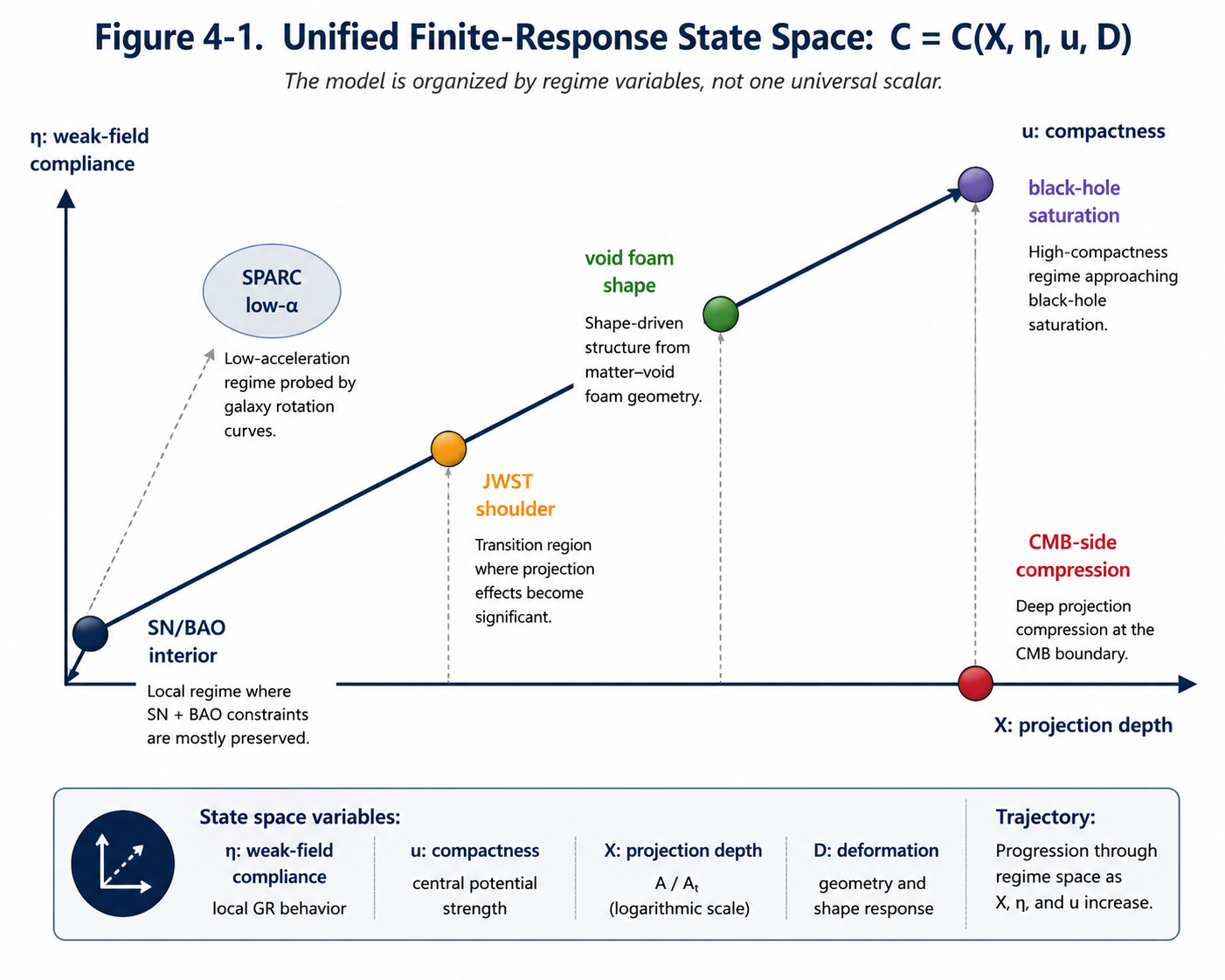
This chapter integrates the components developed previously. The redshift sector utilizes the path-response law \(A(d)=\ln(1+z)\), while the observational sector provides the finite-depth coordinates and projection registers. The synthesis organizes projection, gravity, morphology, and compactness through the variables \(X, \eta, u,\) and \(D_n\).
Key symbols used throughout the model are summarized on the Measurement Registers page.
2. Local Gravity as the Interior Boundary Condition
To ensure the model remains physically viable, it must first be proven that it does not break the laws of physics we have already verified in our own solar system. Therefore, the interior stable register is designed to match General Relativity in the local, weak-field limit. In this regime, a spherical mass is represented by a three-dimensional spatial deformation and a coupled local clock-rate field. The spatial line element is expressed as:
The clock-rate field follows the same deformation:
Substitution yields:
Equations (4-1) through (4-3) reproduce the isotropic Schwarzschild exterior form when written as three-dimensional space with a lapse-like local time factor. In the weak-field expansion, the effective post-Newtonian parameters are \(\beta = 1\) and \(\gamma = 1\). This ensures the model maintains the standard local solar-system limit used for light deflection, Shapiro delay, redshift, and perihelion advance [74] [75].
See the Quantitative Appendix for the local weak-field expansion note.
This defines the role of space and time in the model. Space is the deformable three-dimensional domain, while time is a positive local ordering of physical change. While they are distinct dimensions, local observations require the clock-rate register to remain coupled to the spatial deformation.
3. Model Definition
Definition 4.1. A finite deformable boundary cosmology consists of the following linked structures:
3.1 Local 3D-plus-Clock Gravity
This defines the interior gravitational limit and is not re-fit cosmologically.
3.2 Cosmological Path Response
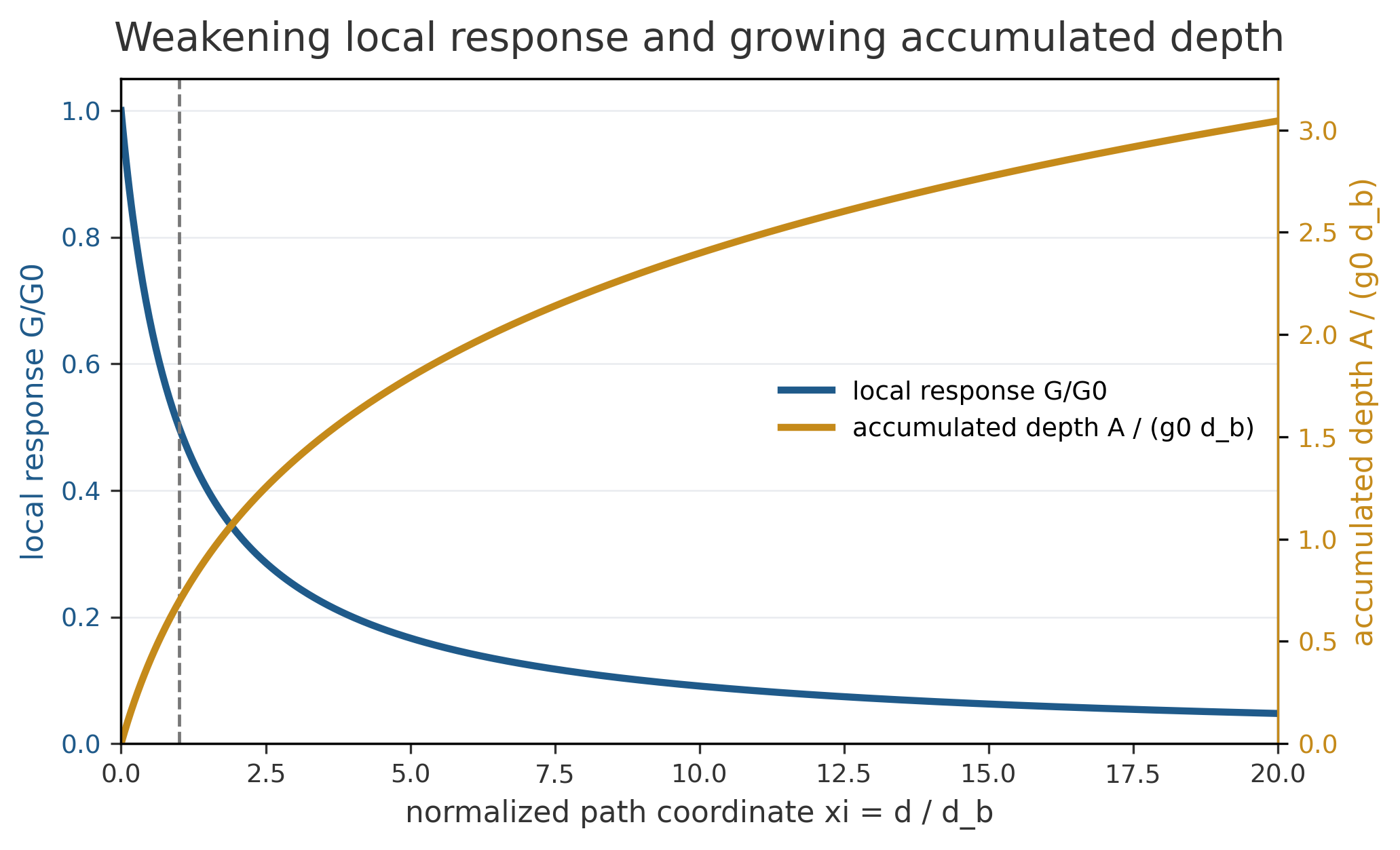
Rather than viewing redshift as a result of space expanding, this model treats it as a record of the total interaction a photon has with the geometry of the path it traveled. The response is defined by the integral of a local rate over the path distance:
In this expression, \(d\) and \(d_b\) share distance units, \(g_0\) has inverse-distance units, and \(p = g_0d_b\) is dimensionless.
See the Quantitative Appendix for finite-response inversion and units.
Technical note
Since \(A = \ln(1+z)\), the inverse finite path coordinate is:
Technical note
With \(p = g_0 d_b\) and \(\xi = d/d_b\):
3.3 Register-Split Cosmological Distances
Rather than forcing all observables into one universal register, the model separates distances into specific roles:
The finite-model radial register is written as \(D_H = dD_R/dz\), which is equivalent to \(c/H_{\text{eff}}(z)\) if an effective Hubble register is defined. This is distinct from the standard \(\Lambda\text{CDM} H(z)\).
The empirical luminosity register yields \(q_L \approx 1.233\text{ to }1.2335\) when \(p \approx 19.878\) is anchored by the BAO radial/transverse shape. While standard metric distance-duality corresponds to \(q_L=1\) when \(q_A=1\) [76] [77], the finite model interprets \(q_L \neq 1\) as a real luminosity/time-transfer projection effect.
3.4 Reverse-Solved Projection Law
The projection law is derived by working backward from the observed boundaries of the universe. Think of this as a "reverse-engineering" process: the law is constructed specifically to satisfy three primary observational anchors: the preservation of the BAO range, the JWST mass-size estimates, and the CMB compression band.
This construction is used as the organized projection target. This approach aligns with conformal methods in cosmology, where metric rescalings preserve angular structure while altering length-scale relations [1] [82]. While distinct from a direct conformal transformation of the metric, the model uses empirical finite-register mappings to organize distance, angular-size, and acoustic-scale behavior.
See the Quantitative Appendix for projection-transition definitions and stage diagnostics.
3.5 Finite-Deformation Curvature Bridge
To connect these registers to the underlying geometry, the local three-dimensional curvature relation is extended by a finite-response correction:
\(F(X)\) and \(Q(X)\) are dimensionless response functions, and \(L_F\) is a finite-response length scale. In the local limit:
See the Quantitative Appendix for curvature-bridge definitions and response-register notation.
\[F(X) \rightarrow 1, \quad Q(X) \rightarrow 0 \quad \text{for } X \ll 1. \tag{4-17}\]
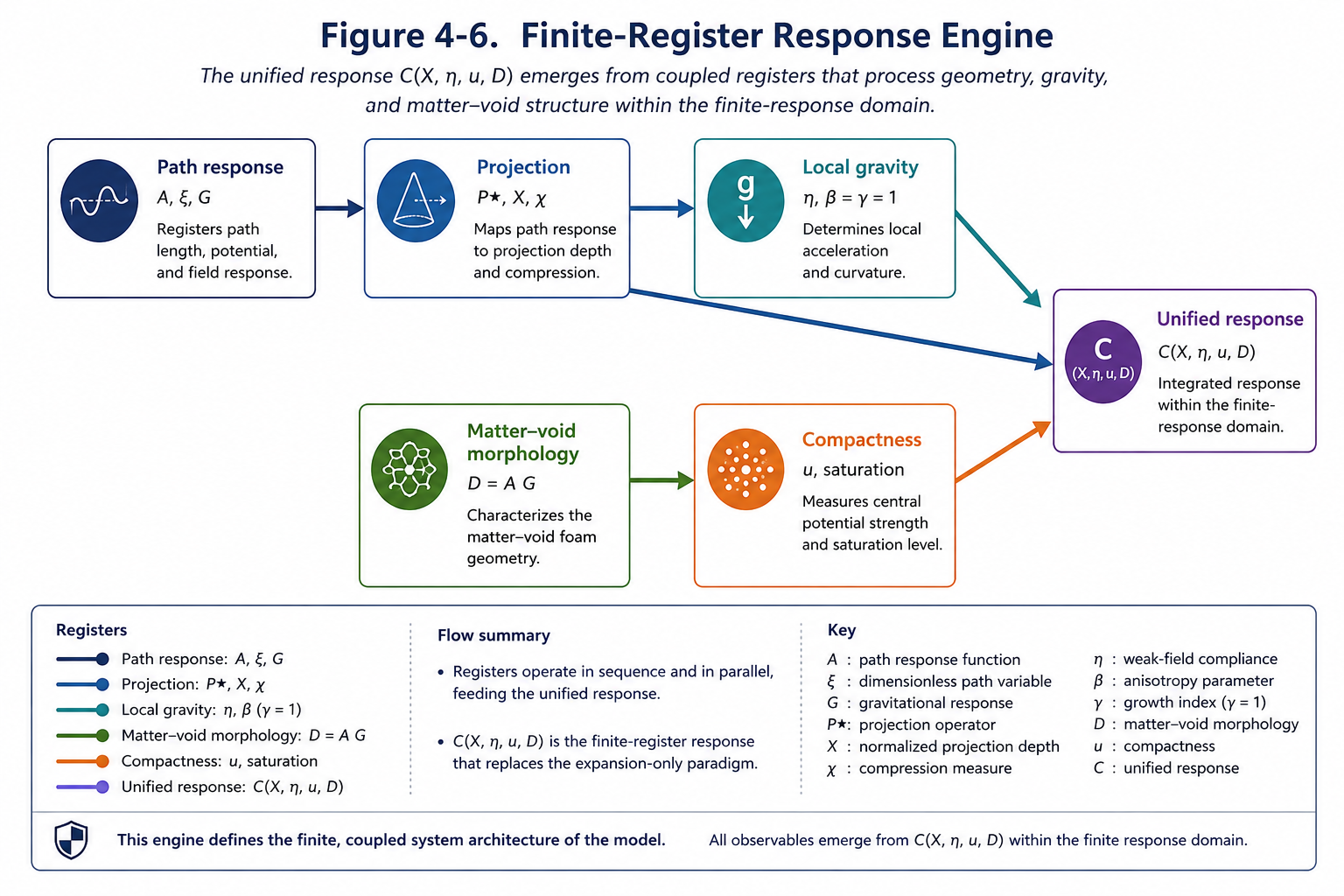
The long-term theoretical target is a unified response engine:
Technical note
Here, \(X\) is projection depth, \(\eta\) is weak-field gravity compliance, \(u\) is compactness, and \(D_n = D/D_0\) is the normalized matter-void morphology coordinate.
4. Dimensionless Finite-Register Dictionary
The model employs dimensionless registers to keep measurement scales distinct. Redshift is measured directly and then mapped into several specialized coordinates, as shown in Figure 4-3.
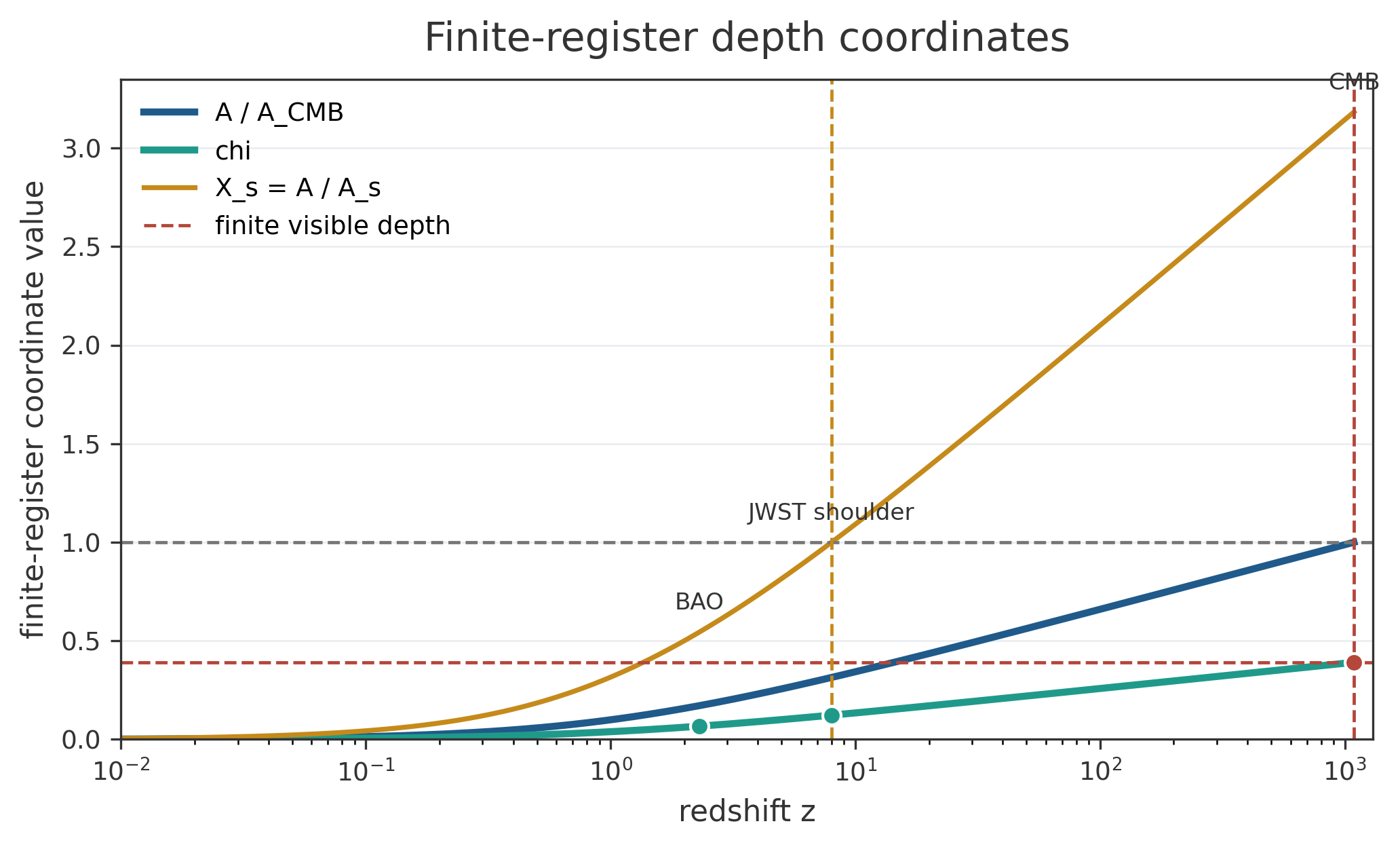
Table 4-1. Dimensionless finite-register dictionary.
| Register | Definition | Role |
|---|---|---|
| \(z\) | Observed redshift | Measured spectral shift |
| \(A = \ln(1+z)\) | Accumulated path response | Redshift bookkeeping register |
| \(\xi = d/d_b\) | Normalized path coordinate | Finite path depth from the response solution |
| \(G = 1/(1+\xi)\) | Local response rate | Weakening incremental response |
| \(X = A/A_s\) | Projection-depth coordinate | \(X=1\) at the preferred JWST-centered projection shoulder |
| \(\chi = f_{\mathrm{vis}} A/A_{\mathrm{CMB}}\) | Finite-depth display coordinate | Places BAO, JWST, and CMB on one compact depth scale |
| \(D = AG\) | Morphology response | Raw matter-void foam coordinate |
| \(D_n = D/D_0\) | Normalized morphology response | Response-function argument; \(D_0\) shares units with \(D\) |
| \(\eta = g_{\mathrm{bar}}/g^\dagger\) | Weak-field gravity coordinate | SPARC/RAR-style compliance register |
| \(u = 2GM/(Rc^2)\) | Compactness coordinate | Black-hole/finite-saturation register |
| \(P_{\star}(z)\) | Projection factor | Mass-size/acoustic projection conversion |
5. Register Scaling Parameters and Response Weighting Diagnostics
The finite-register dictionary separates the observables. The K-values below are used provisionally to test how those registers might enter the response engine as distinct weights:
Under this diagnostic reading, \(K_D \sim 1/2\) is compatible with a square-root transport response, \(K_X \sim 1\) is compatible with nearly proportional projection ordering through the interior and approach regime, and \(K_\eta \sim 2/3\) is compatible with dimensional-coupling behavior in the weak-field gravity register. The compactness-sector test was attempted but did not yet recover a clear \(K_u\); for the full cosmology, \(K_u=1/3\) is used only as a trial radial-collapse exponent. The alternate outcome is \(K_u\sim0\), where compactness behaves as a saturation switch rather than a broad scaling register.
This is the diagnostic scaling form of the response engine. It does not replace the curvature bridge or the projection law; it records how provisional register parameters can be tested inside the finite-boundary cosmology. If the K-values fail under independent data or alternate parametrization, the geometric register framework remains testable without them.
Table 4-2. Provisional register scaling weights.
| Register | Scaled form | Diagnostic status | Cosmological role |
|---|---|---|---|
| Matter-void morphology | \(D_n^{K_D}\) | fitted \(K_D \sim 1/2\) | Possible transport-like foam response |
| Projection depth | \(X^{K_X}\) | fitted \(K_X \sim 1\) | Possible coherent interior-to-shoulder ordering |
| Weak-field compliance | \(\eta^{K_\eta}\) | fitted \(K_\eta \sim 2/3\) | Possible dimensional coupling in galaxy-scale response |
| Compactness | \(u^{K_u}\) | trial \(K_u=1/3\); alternate \(K_u\sim0\) | Unresolved radial-collapse or saturation-threshold test |
6. Reverse-Solved Projection as the Organizing Construction
The projection law is fixed by working backward from specific observational anchors. The BAO requires the low-redshift acoustic-shape range to remain nearly unchanged. The JWST requires the high-redshift galaxy conversion to shift stellar mass downward and effective radius upward. Finally, the CMB requires the far-side acoustic projection to approach the compressed scale identified by the BAO-CMB shared-ruler failure. This is why \(P_{\star}\) is treated as the organizing construction for the cosmology, while its physical derivation remains a primary model-building target.
Earlier transitions placed the midpoint near \(z_t \approx 34.6\). While that transition reached the CMB-side compression, it was nearly unity at \(z \approx 8\) and thus did not alter JWST galaxy sizes. The reverse solution shifts the projection shoulder into the JWST regime while increasing sharpness to preserve the BAO range.
Table 4-3. Anchor values for the preferred projection law \(P_{\star}\).
| Regime | \(z\) | \(A = \ln(1+z)\) | \(\chi\) | \(P_{\star}\) | Mass ratio \(P^2\) | Radius ratio \(1/P\) |
|---|---|---|---|---|---|---|
| BAO high end | 2.3 | 1.1939 | 0.0667 | 0.999971 | 0.9999 | 1.0000 |
| JWST shoulder | 8 | 2.1972 | 0.1228 | 0.686143 | 0.4708 | 1.4574 |
| CMB side | 1089.92 | 6.9948 | 0.3909 | 0.372286 | 0.1386 | 2.6861 |
At \(z = 2.3\), \(P_{\star} = 0.999988\), meaning the BAO range is nearly unchanged. At \(z = 8\), \(P_{\star} = 0.686143\). In the JWST mass-size register, this implies \(M_{\text{new}}/M_{\text{standard}} \approx P_{\star}^2 \approx 0.4708\) and \(R_{\text{new}}/R_{\text{standard}} \approx 1/P_{\star} \approx 1.457\). At \(z = 1089.92\), \(P_{\star}\) approaches 0.372286, matching the compressed asymptote required by the CMB-side projection band.
7. Observable Sectors of the Cosmology
7.1 Redshift and Supernova Luminosity
The supernova sector utilizes the path-response solution and luminosity register. Redshift is treated as \(A = \ln(1+z)\), the radial path coordinate is \(d(z)\), and observed brightness is compared through \(D_L = (1+z)^{q_L} D_M\). This effectively separates spectral shift, finite path length, and luminosity transfer. Consequently, the supernova curvature that motivated Chapter 1 is preserved as the interior path-response sector of the cosmology.
7.2 BAO Radial/Transverse Shape
The BAO anisotropy sector uses the register ratio:
Since the absolute ruler scale \(r_d\) cancels from \(\Delta z/\theta\) (as shown in Chapter 1), this sector compares the shape of radial and transverse distances before imposing a shared acoustic calibration. The finite model uses the same path coordinate \(d(z)\) for \(D_M\) and the derivative register \(dD_R/dz\) for \(D_H\).
7.3 BAO-CMB Acoustic Projection
The BAO-CMB shared-ruler failure is represented as a projection-boundary effect rather than a failure of local gravity. \(P_{\star}\) leaves the BAO redshift range nearly unchanged while shifting the CMB-side register toward the high-redshift compressed band. The near-unity scaling \(K_X \sim 1\) is consistent with this behavior, but it is not the basis for the projection-boundary claim; the claim rests on the independent BAO, CMB, and high-redshift tests.
7.4 Time Dilation
Technical note
The time-stretch sector follows from the same accumulated response. Since \(A = \ln(1+z)\), arrival intervals stretch as:
Technical note
The model therefore predicts the standard \(b=1\) time-dilation exponent, interpreting the stretching as a path-response timing register rather than as evidence that all registers must share a single FLRW expansion scale.
7.5 High-Redshift Galaxy Mass and Size
JWST high-redshift galaxies serve as direct tests of derived quantities. While spectroscopic redshift, flux, and angular size are direct observables, stellar mass, luminosity, physical size, and compactness are inferred through cosmological conversion. In the finite projection register, the leading conversion is:
Flux-based inferred mass scales with luminosity-distance squared, while physical radius scales through the angular-size-distance register. The projection factor is used here as a diagnostic scaling (see the quantitative appendix). Thus, the same projection shoulder that preserves BAO and reaches the CMB-side limit moves \(z \approx 8\) galaxy properties toward lower inferred mass, larger radius, and lower compactness.
See the Quantitative Appendix for the diagnostic mass-size scaling details.
7.6 Weak-Field Gravity
The galaxy-scale gravity register uses:
The corresponding compliance function is written as:
This register integrates low-acceleration galaxy behavior into the finite-response vocabulary without altering the local high-acceleration GR-compatible limit. The associated \(K_\eta \sim 2/3\) scaling is treated as a provisional indication of dimensional-coupling behavior, not as a derived law.
7.7 Matter-Void Morphology
The matter-void sector employs:
This register treats the cosmic web as a matter-plus-void foam, rather than merely a distribution of matter points. \(D\) combines the accumulated path response with the local weakening rate to provide the raw morphology coordinate developed in previous chapters. Under the provisional \(K_D \sim 1/2\) weighting, the morphology sector can be tested as a transport-like weakening-response register.
7.8 Compactness and Finite Saturation
The compactness sector uses:
In the finite-domain interpretation, \(u\) is a regime coordinate that approaches saturation rather than literal physical infinity. Singular behavior marks the edge of a response law's domain, not the required existence of infinite physical density.
The compactness-sector test attempted with available black-hole mass and lag-radius data was not decisive. For the model definition, the compactness register therefore carries only the trial exponent \(K_u=1/3\), representing a radialized-collapse hypothesis. If future data instead favor \(K_u\sim0\), compactness would be interpreted as a saturation-threshold register rather than a scaling register.
8. Unified Finite-Response Engine
The finite-boundary cosmology is not a collection of unrelated corrections; its observable sectors are faces of a single deformable domain. Projection depth, path response, weak-field gravity, foam morphology, and compactness are integrated into the response engine, while register scaling remains a provisional diagnostic layer:
The curvature bridge, projection law, and observational registers are connected via:
\(F\) and \(Q\) are components or limiting cases of the broader finite-response function \(C(X, \eta, u, D_n)\). In the local regime, \(F \rightarrow 1\) and \(Q \rightarrow 0\). The finite-boundary regime activates projection, morphology, weak-field, and compactness registers without requiring the provisional K-values to be fundamental.
9. Cosmological Picture
The resulting universe is a finite deformable boundary system. Its interior is locally stable and GR-compatible. Redshift accumulates as path response rather than as a direct reading of a universal expansion scale. BAO radial/transverse shape follows the interior path register. At greater finite depth, the projection shoulder appears in the high-redshift galaxy regime, altering inferred mass and size. Beyond that, the acoustic projection approaches the CMB-side compressed register.
This framework explains why different observables can agree locally yet diverge globally. A clock, a wavelength, a ruler, an angular size, a luminosity, a void shape, a galaxy rotation curve, and a compactness boundary are all internal measurements, but they do not necessarily remain locked to a single background scale across the full finite domain.
The model's central physical claim is that the universe does not require an infinite external stage or a single universal measurement register. Instead, it is a finite deformable event-domain where internal observables separate into stable local registers, approach registers, projection registers, and compressed boundary registers.
10. Empirical Correspondence
Table 4-4. Empirical correspondence of the finite-boundary cosmology.
| Sector | Register | Scaling behavior | Model Role |
|---|---|---|---|
| Local gravity | 3D+clock exterior | ordinary high-acceleration limit | \(\beta=1, \gamma=1\) weak-field limit |
| Supernovae | \(A(d), d(z), D_L\) | path-response sector; no independent \(K\) isolated | nonlinear redshift-distance curvature as path response |
| BAO shape | \(D_M/D_H\) | consistent with fitted \(K_X \sim 1\) | radial/transverse anisotropy without absolute-ruler dependence |
| BAO-CMB | \(P_{\star}\) high-z asymptote | projection compression after coherent interior ordering | compressed acoustic projection band |
| JWST galaxies | \(P_{\star}\) mass-size conversion | projection-shoulder response | lower mass, larger radius, lower compactness |
| Time dilation | A timing register | inherits \(A=\ln(1+z)\) | \(\Delta t_{\text{obs}}=\Delta t_{\text{em}}(1+z)\) |
| SPARC/RAR | \(\eta\) | fitted \(K_\eta \sim 2/3\) | weak-field compliance register |
| Voids/foam | \(D=AG\) | fitted \(K_D \sim 1/2\) | matter-void morphology register |
| Compactness | \(u\) | trial \(K_u=1/3\); alternate \(K_u\sim0\) | finite saturation register with unresolved radial-collapse test |
From a model-building perspective, the core framework is defined by local GR-compatible gravity, accumulated path response, register-split distances, the reverse-solved projection construction \(P_{\star}\), and the unified response engine \(C(X, \eta, u, D_n)\). The K-values remain provisional diagnostics attached to that framework. Further development must test whether they survive stronger data and physical derivation rather than assuming they fix the cosmological structure.
11. Definition and Status of the Finite-Boundary Model
The finite deformable boundary cosmology is defined by six fundamental statements:
1. The universe is a finite deformable event-domain, rather than an object measured from an external infinite ruler.
2. Local gravity is the GR-compatible interior limit, expressed as three-dimensional spatial deformation plus a coupled positive clock-rate field.
3. Observed redshift is accumulated path response:
4. Cosmological observables occupy separate but linked finite registers: \(D_R, D_H, D_M, D_L, D_A\), timing, acoustic projection, morphology, gravity compliance, and compactness.
5. The preferred projection construction is fixed by BAO preservation, JWST mass-size conversion, and CMB-side compression:
6. The full finite-response engine can be examined with provisional register scaling, with fitted values \(K_D\sim1/2\), \(K_X\sim1\), and \(K_\eta\sim2/3\), and with compactness assigned only the trial value \(K_u=1/3\):
The register-scaling result changes only the diagnostic status of the model. The finite-register framework remains a way to keep observables separated; the fitted values \(K_D \sim 1/2\), \(K_X \sim 1\), and \(K_\eta \sim 2/3\) are clues that morphology response, projection depth, and weak-field compliance may occupy different scaling regimes. They may also be artifacts of the present construction. The compactness-sector test was attempted but remains inconclusive, so \(K_u=1/3\) is used only as a working trial for radial collapse scaling. A future model must test why these registers favor a low-order exponent family, or reject that pattern if it does not survive.
The model is designed to match local weak-field gravity by construction, reproduce the path-response redshift sector, preserve the BAO radial/transverse regime, shift JWST high-redshift mass-size inferences in the required direction, and reach the CMB-side compressed projection band. Remaining quantitative development includes full covariance likelihoods, a complete CMB-spectrum implementation, homogeneous JWST population remeasurement, numerical evolution of the unified response engine, and a stronger compactness-sector test of \(K_u=1/3\) against the \(K_u\sim0\) saturation-only alternative.
The cosmology is therefore a defined finite-register model of a universe with stable local behavior, finite-depth path response, a projection shoulder, and a compressed boundary-side register.