Chapter 3
Chapter 3: A Finite Deformable Universe
Chapter 3 figure anchors
Abstract
A finite deformable universe model is assembled from the empirical and diagnostic results developed in the preceding chapters. The redshift analysis treated redshift as an accumulated path response, \(A(d) = \ln(1+z)\), with a local response \(G(d) = g_0/(1+d/d_b)\), and identified a BAO-CMB shared-ruler failure requiring a sharp projection transition. The observational-register analysis recast that transition into a dimensionless depth coordinate, evaluated JWST mass-size projection behavior, expressed the SPARC radial-acceleration relation as weak-field compliance, and established matter-void foam and compactness-boundary screens. These elements define a visual model of a finite deformable geometric domain.
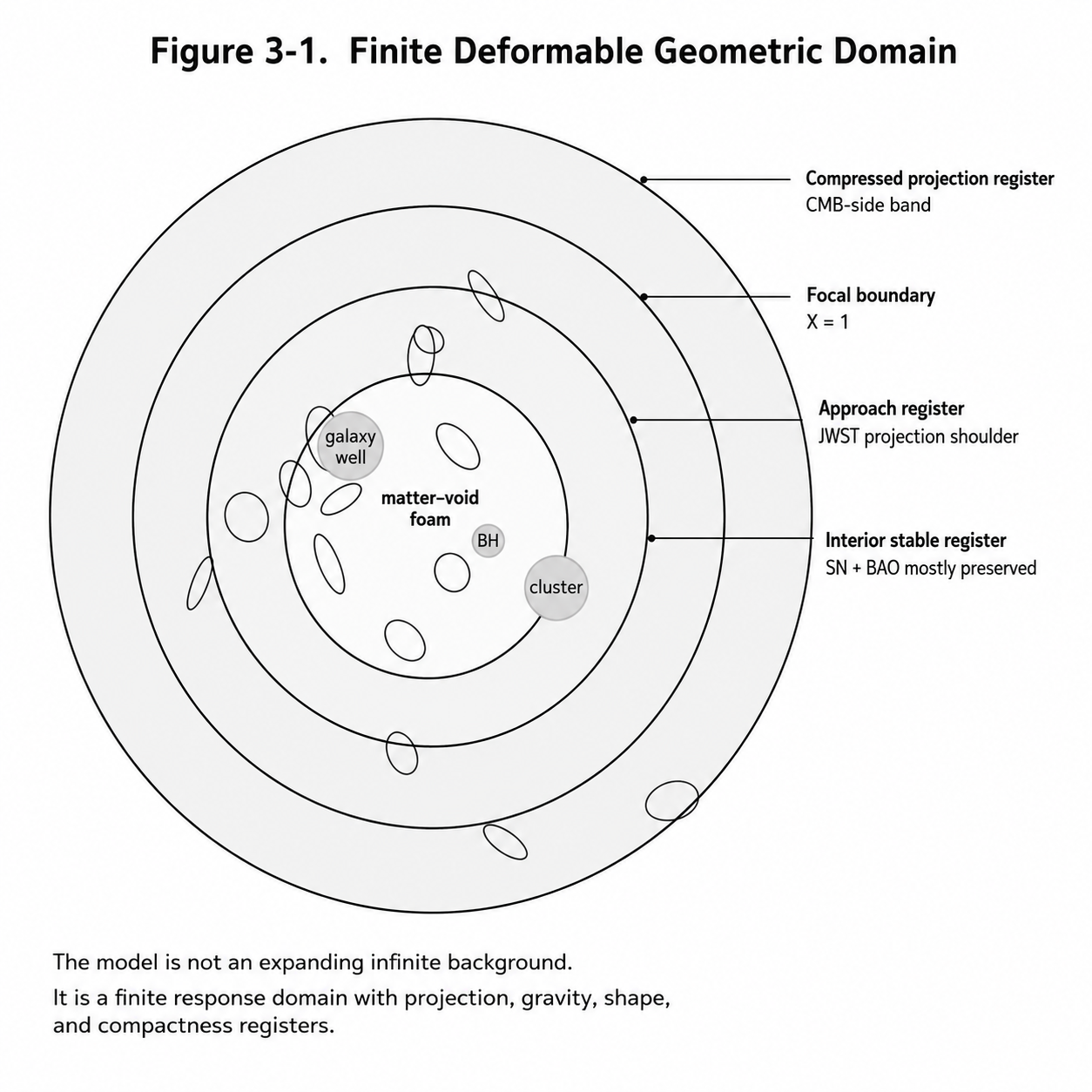
The central proposal is that observed redshift, inferred size, local gravitational response, void architecture, and compactness limits are different observational registers of a single finite geometry. The model utilizes \(X = A/A_t\) as a normalized transition coordinate, \(D = AG\) as a raw morphology response coordinate, \(\eta = g_{\text{bar}}/g^\dagger\) as a weak-field compliance coordinate, and \(u = 2GM/(Rc^2)\) as a compactness coordinate. When morphology is processed through the response engine, \(D\) is normalized as \(D_n = D/D_0\), where \(D_0\) shares the same units as \(D\). These registers are collected into a generalized finite-response function \(C(X, \eta, u, D_n)\), which defines the testable relations among projection, gravity, morphology, and compactness.
A register-scaling audit identifies three fitted dimensionless values: \(K_D \approx 0.505\), \(K_X \approx 0.980\), and \(K_\eta \approx 0.666\). Their proximity to the low-order forms \(1/2\), \(1\), and \(2/3\) is treated as a diagnostic pattern, not as a derived physical law. These K-values may reflect variable definitions, imposed constraints, or limited data, so they remain adjustable and testable within the model.
A first compactness-sector test was attempted using available black-hole mass and lag-radius data, but it did not recover a clear empirical \(K_u\). The result leaves two testable possibilities: \(K_u \sim 1/3\) if compactness behaves as a radialized collapse-scaling register, or \(K_u \sim 0\) if compactness acts mainly as a saturation threshold. The working model carries \(K_u = 1/3\) forward only as a trial compactness parameter to be tested, not as a recovered constant.
1. Model Premise
The model is designed as a visual framework, though it remains rigorously constrained. The coordinates \(A, \chi, X, D, \eta,\) and \(u\) are treated as separate registers; ordinary local physics must be preserved, and every proposed register must point to a measurable success or failure condition.
Previous observational analyses reorganized real observables under a finite deformable geometry interpretation. The objective is to determine the nature of a universe in which these strong relationships appear as integrated parts of a single geometry.
The fundamental concern is physical infinity. Infinite space, infinite time, singular density, negative time, and negative physical volumes may be useful mathematical limits, but they are not automatically physical structures. A finite event-domain provides the setting in which redshift, gravity, void space, and compactness emerge from within the domain.
The model is tied to specific empirical patterns: the supernova path-response relation, the BAO-CMB shared-ruler failure, the approximate 0.39 CMB-to-BAO scale ratio, the JWST mass-size direction of effect, the SPARC acceleration transition, the matter-void foam result, and the compactness-boundary target.
The register-scaling result is useful but limited. The appearance of \(1/2\), \(1\), and \(2/3\)-like behavior may point to transport, projection coherence, and dimensional coupling within the finite domain, but it may also reflect the way the registers and fits were constructed. The geometry therefore does not depend on these K-values being fundamental.
The compactness register is less settled. A black-hole test was attempted as an initial check, but the available radius information did not isolate a stable compactness exponent. This does not remove compactness from the model; it clarifies its status. The model treats \(K_u=1/3\) as a trial value for radial collapse scaling, while keeping \(K_u\sim0\) as the competing saturation-only outcome.
2. Assumptions and Operating Constraints
Table 3-1. Operating assumptions.
| Assumption | Role in the Model |
|---|---|
| Finite domain | The observable universe is treated as a finite geometric event-domain, rather than an infinite background. |
| Local stability | Ordinary local physics, laboratory behavior, solar-system behavior, and high-acceleration systems remain effectively unchanged. |
| Redshift as path response | Observed redshift is measured normally, but its accumulation is modeled as a path response through deformable geometry. |
| Projection registers | Luminosity distance, angular-size distance, wavelength, timing, and ruler scale are treated as related but separable observational registers. |
| Matter and voids together | The cosmic web consists of both matter and the void spaces between structures; both are part of the shape signal. |
| No physical infinities | Singularities and unbounded extrapolations are treated as indicators that a response law has left its domain. |
| Testability | Equations, assumptions, predictions, and failure tests are stated explicitly. |
3. Coordinate Dictionary
Technical note
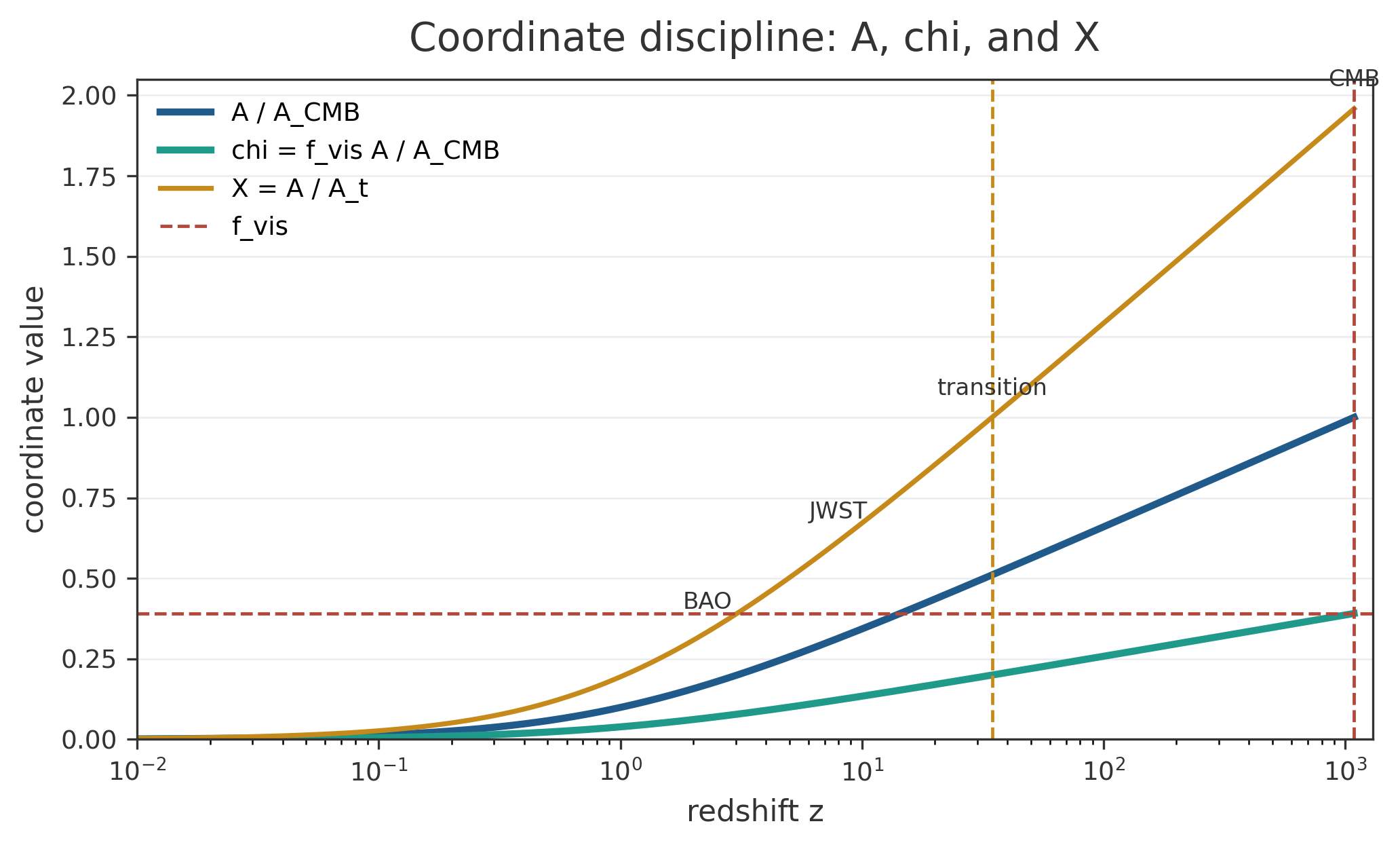
Coordinate separation ensures model coherence. \(A = 0.2\) is not the same statement as \(\chi = 0.2\). The master comparison coordinate is \(X = A/A_t\), where \(X = 1\) marks the principal projection boundary recovered from the BAO-CMB shared-ruler failure.
Table 3-2. Coordinate dictionary.
| Symbol | Role | Meaning |
|---|---|---|
| \(z\) | Observed redshift | Measured spectral shift; not itself a distance. |
| \(A(z)=\ln(1+z)\) | Accumulated path deformation | Core redshift bookkeeping coordinate. |
| \(G(d)=g_0/(1+d/d_b)\) | Local response rate | Declining contribution to accumulated response along path length. |
| \(D=AG\) | Shape/morphology response | Raw matter-void coordinate used for shape screens. |
| \(D_n=D/D_0\) | Normalized morphology response | Response-engine argument; \(D_0\) shares units with \(D\). |
| \(\chi=f_{\mathrm{vis}} A/A_{\mathrm{CMB}}\) | Finite-depth display coordinate | Scaled display coordinate used for visual regime ordering. |
| \(X=A/A_t\) | Normalized focal coordinate | \(X=1\) marks the main projection boundary. |
| 0.390906 | CMB/BAO scale ratio | A scale ratio, not redshift, \(A\), or \(\chi\). |
| \(\eta=g_{\mathrm{bar}}/g^\dagger\) | Weak-field gravity coordinate | Controls local gravitational compliance. |
| \(u=2GM/(Rc^2)\) | Compactness coordinate | Controls black-hole saturation target. |
The key definitions are:
4. Register Scaling Parameters as Provisional Diagnostics
The coordinate dictionary separates the model into observational registers. The fitted K-values are retained as a diagnostic way to compare how those registers behave, not as foundational constants. Independent finite-response registers currently return the following low-order-like exponents:
This exponent triplet is a candidate scaling pattern within the finite-response framework. It may connect morphology response, projection depth, and weak-field compliance as different regimes of one deformable system, but it may also be partly an artifact of imposed model constraints. The compactness exponent is not empirically recovered; a trial value is carried only as a hypothesis from the same geometric logic:
The alternative is \(K_u \sim 0\), where compactness behaves less like a broad scaling register and more like a threshold that activates saturation near \(u\approx1\).
Table 3-3. Provisional register scaling diagnostics.
| Register | Quantity | Fitted or assigned \(K\) | Simple form | Diagnostic reading |
|---|---|---|---|---|
| Morphology/path response | \(D = AG\) | 0.504869 | \(1/2\) | Possible transport-like weakening-response behavior |
| Projection coordinate | \(X = A/A_t\) | 0.980376 | \(1\) | Possible coherent projection ordering |
| Weak-field compliance | \(\eta = g_{\mathrm{bar}}/g^\dagger\) | 0.666348 | \(2/3\) | Possible dimensional coupling in the low-acceleration response |
| Compactness | \(u = 2GM/(Rc^2)\) | not isolated | trial \(1/3\); alternate \(0\) | Unresolved radial-collapse or saturation-threshold test |
Diagnostic Interpretation of the Scaling Parameters
The near-half exponent \(K_D \sim 1/2\) is compatible with a geometric-transport pattern. Half-order behavior can appear when spreading or propagation grows while the local response weakens. In the register \(D = AG\), accumulated path response grows through the domain while \(G\) decays with scale, but this does not by itself prove a square-root physical law.
The near-linear exponent \(K_X \sim 1\) is compatible with coherent projection mapping. Because \(X = A/A_t\) is the normalized projection coordinate, near-unity scaling may indicate that the BAO-side and interior projection register preserve proportional ordering before the compressed boundary-side behavior dominates.
The near-two-thirds exponent \(K_\eta \sim 2/3\) may point to dimensional coupling in weak-field gravity. Two-thirds scaling can appear when surface-like and volume-like behavior are linked. In the SPARC/RAR register, it is consistent with a distributed-response picture in which baryonic organization and geometric compliance co-evolve across the low-acceleration regime [50] [51].
Together, \(K_D\), \(K_X\), and \(K_\eta\) provide a useful diagnostic comparison among registers. The next theoretical target is to determine whether these values survive independent data, alternate parametrizations, and first-principles derivation, or whether they are artifacts of the present model construction.
Compactness-sector status
A compactness-sector test was attempted using black-hole mass and reverberation lag-radius information. The result was not clear enough to claim an empirical \(K_u\). The strongest lesson from the test is methodological: imposed projection shifts must be separated from measured compactness structure before a compactness exponent can be trusted.
The theoretical expectation remains a hypothesis. If compactness is governed by radialized collapse from a volume-like deformation regime, the trial exponent is \(K_u\sim1/3\). If compactness is instead a boundary switch, the effective exponent is closer to \(K_u\sim0\), with the response activating near \(u\approx1\). For the full cosmology, \(K_u=1/3\) is carried forward only as a working value to be tested against stronger black-hole data.
5. The Finite Geometric Domain
The model treats the universe as a finite deformable event-domain. This does not necessitate a literal physical boundary in ordinary space; rather, it means the event has a bounded geometric register: path response, projection, and compactness approach limiting behavior rather than physical infinity. In the schematic domain notation below, \(X(x)\) is a model-assigned depth coordinate for an event or signal path, and \(X_{\max}\) is the maximum depth covered by the chosen model domain.
See the Quantitative Appendix for domain-coordinate notation and response-register definitions.
Interior observations are defined by \(X < 1\). The focal projection boundary occurs at \(X = 1\). CMB-side projection behavior resides in a compressed register beyond this transition. Local objects may sit deep inside the domain while entering a different regime through \(\eta\) or \(u\). For this reason, the model utilizes several registers rather than a single universal scalar.
6. Path-Response Redshift
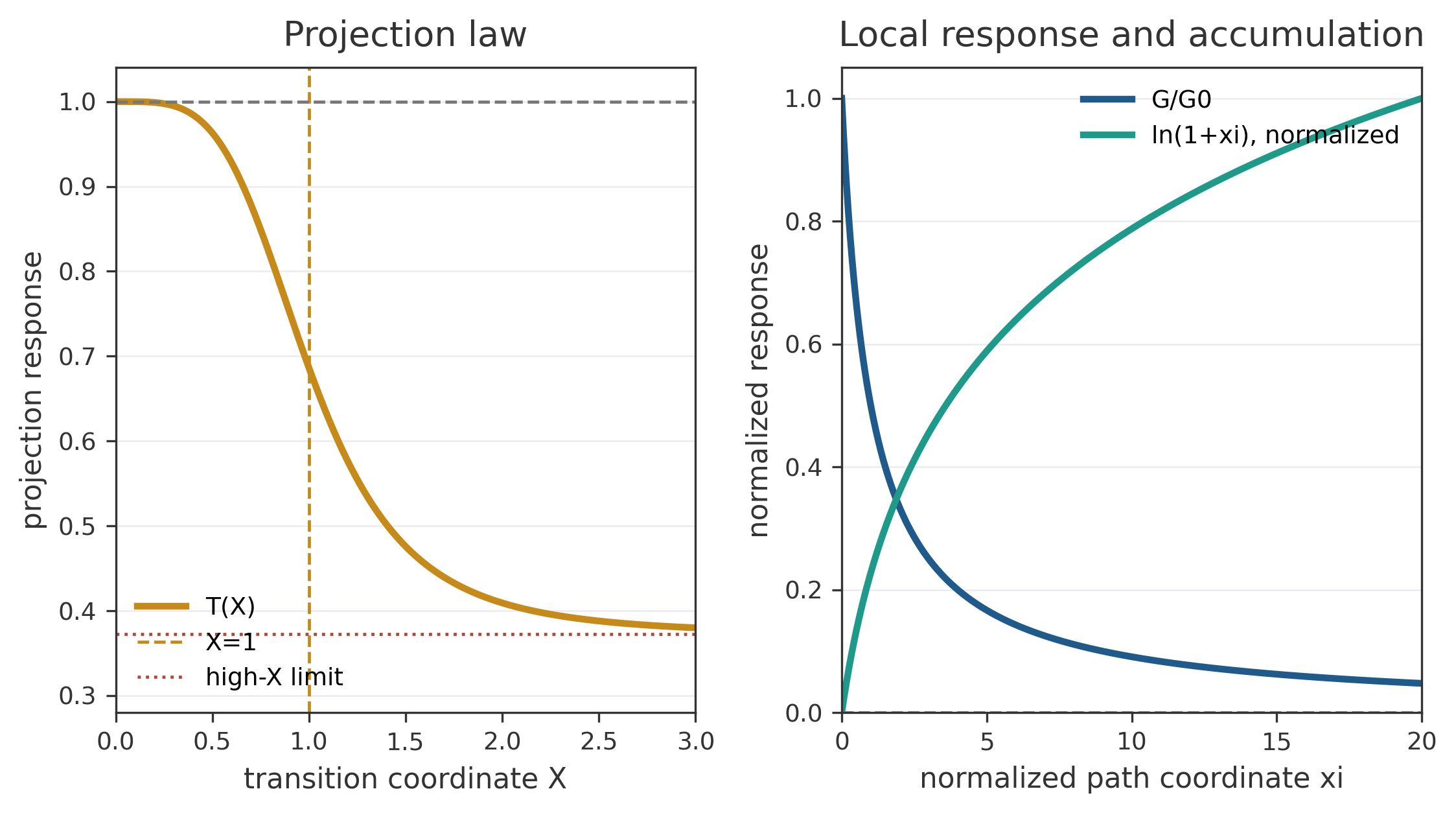
The redshift law is constrained by the earlier redshift-distance analysis. Redshift is treated as an accumulated response along a signal path through deformable geometry. The observable redshift remains unchanged; only the interpretation of its accumulation is refined.
This response law produces a nonlinear redshift-distance curve without requiring local light speed to vary. Light continues to propagate locally at \(c\), while wavelength, timing, and inferred projection registers accumulate through the geometry crossed by the signal.
7. Projection Boundary and Focal Normalization
Technical note
The BAO-CMB shared-ruler failure requires a sharp transition. A broad rescaling would disturb the BAO range. The model therefore places the projection transition at one normalized focal length: \(X = 1\).
For the recovery target, \(\Delta = 0.627714\) and \(m = 4\). The high-\(X\) limit is \(1 - \Delta = 0.372286\), which is close to both the CMB-side compression band and \(e^{-1}\). While the scale ratio 0.390906 remains distinct from \(T(\text{CMB})\), both point to a similar compressed-register magnitude. The near-unity value \(K_X \sim 1\) is consistent with this role for \(X\), but the projection-boundary claim rests on the BAO-CMB and high-redshift tests rather than on \(K_X\) alone.
8. Size and Luminosity Registers
A projection boundary affects inferred quantities before it affects direct observables. Spectroscopic redshift, flux, and angular size are direct measurements. However, stellar mass, luminosity distance, angular-size distance, physical radius, and compactness are inferred through a conversion. If the projection register shifts, mass and size move in opposite directions.
This is the primary JWST prediction. The model does not suggest that the spectra are incorrect; rather, it predicts that a finite-geometry projection conversion makes some high-redshift galaxies appear less massive, larger, and less compact than they would under the standard conversion.
9. Vacuum as a Separation of Registers
The model can be conceptualized as a separation between a physical geometric register and an optical or signal register. Previous conceptual iterations considered a dual expansion picture in which physical expansion outruns the signal register. The present finite-deformable formulation does not require ordinary expansion as the fundamental starting point, yet it preserves the intuition that a vacuum-like register emerges from the separation between geometric behavior and photon-path reporting.
Vacuum is therefore not treated as empty nothing, but as a low-coupling geometric state: a region where matter-linked deformation pressure weakens toward a near-zero response rather than becoming a negative quantity. This frames the pressure idea as a boundary-state question rather than a negative-energy assumption.
10. Gravity as Local Compliance
The SPARC radial acceleration relation serves as the most definitive local compliance target. Baryons remain the local source term, while the effective response of geometry becomes more compliant below a characteristic acceleration scale.
The fitted \(K_\eta \sim 2/3\) scaling is treated as a diagnostic clue that weak-field compliance may occupy a dimensional-coupling regime rather than a simple linear acceleration correction.
\(\eta\) is distinct from \(X\). A galaxy's outskirts can exhibit a small \(X\) but a small \(\eta\), while a high-redshift path can have a large \(X\) without being a local low-acceleration system. This separation is a strength of the model, as it prevents disparate observations from being forced onto a single axis.
11. Matter-Void Foam and Shape Response
The most structurally evident aspect of the model is the matter-void foam. The cosmic web is not merely matter in a background; the voids are integral to the geometry. In a physically meaningful model, void bubbles, walls, filaments, clusters, and local wells should be co-expressions of the same deformable domain.
The SDSS VAST screen indicated that \(D = AG\) improves several shape metrics relative to \(A\) alone, though the result remains mixed due to the shallow nature of the survey. Dimensional entries in the shape vector are standardized before comparison, and \(D_n\) is reserved for response-engine use. The fitted \(K_D \sim 1/2\) scaling is treated as a provisional clue that \(D = AG\) may behave like a transport-like weakening-response coordinate. The model predicts that deeper catalogs sampling closer to \(X = 1\) will show coordinated changes in foam architecture: void ellipticity, basin hierarchy, large-void fraction, and connectivity should not vary independently.
See the Quantitative Appendix for \(D_n\) normalization and unified response notation.
12. Compactness Boundary and Finite Saturation
Black holes serve as the primary compactness test, as they push classical coordinates toward horizon and singularity limits. In a finite deformable geometry, the horizon is a compactness-regime boundary beyond which ordinary exterior coordinates are replaced by a finite saturation law.
\(S(u)\) is the compactness response law used for finite saturation. Weak compactness leaves ordinary exterior gravity unchanged, while compactness near \(u = 1\) activates saturation. A complete theory must preserve exterior Schwarzschild/Kerr behavior, shadows, lensing, and ringdown observations while avoiding a physical singular endpoint.
The initial black-hole compactness test did not isolate a reliable \(K_u\). The working interpretation is therefore predictive rather than recovered: \(K_u=1/3\) is a trial radial-collapse value, while \(K_u\sim0\) remains the threshold-saturation alternative.
13. Unified Finite-Response Engine
The finite-response engine is a generalized constitutive map defining how the geometry responds when projection depth, weak-field acceleration, compactness, or normalized morphology response enters a boundary regime. The K-values provide a provisional diagnostic weighting structure for the response registers, with \(K_u=1/3\) used only as a trial compactness value.
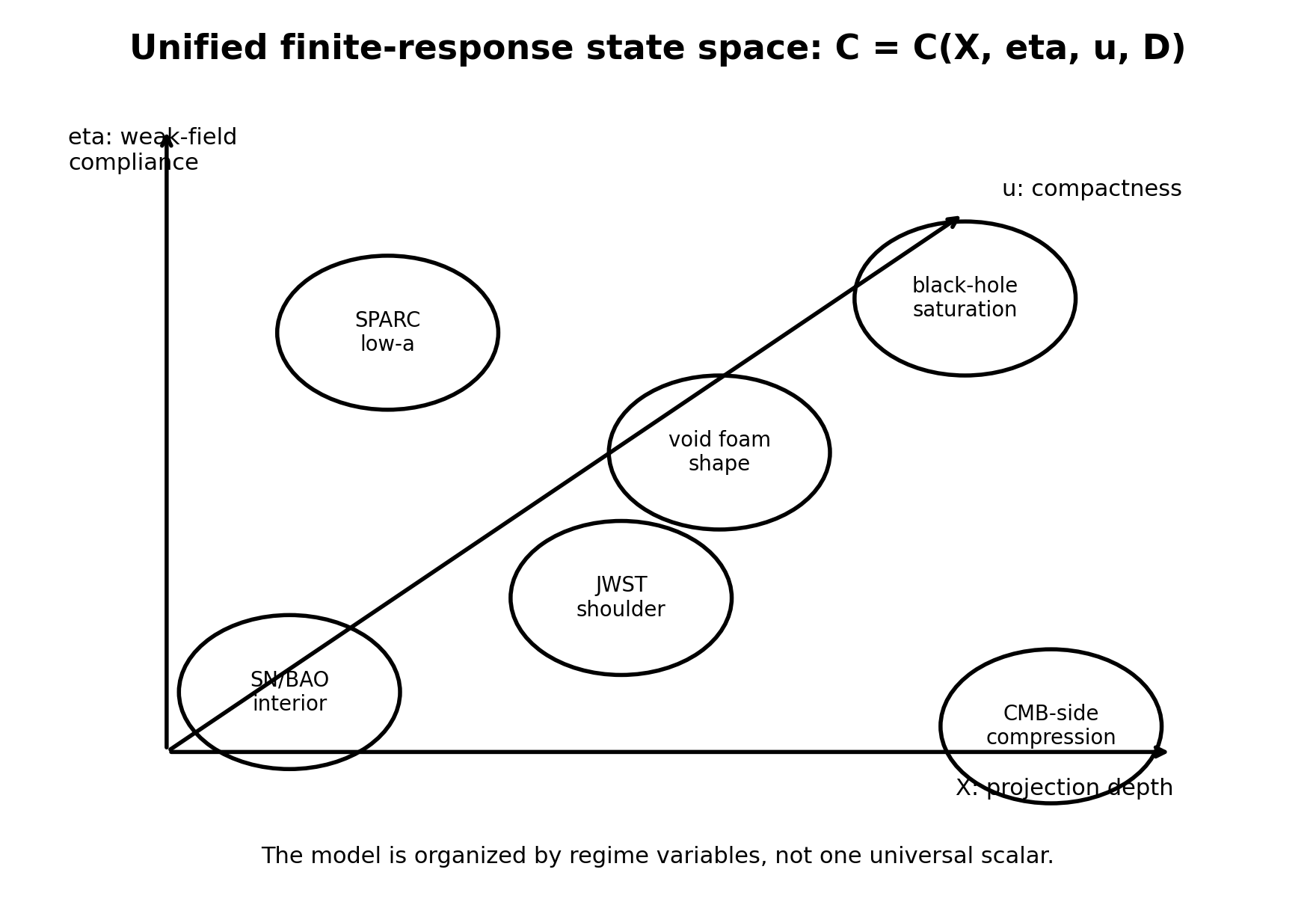
Table 3-4. Response-engine limits.
| Limit | Required Behavior |
|---|---|
| Projection limit | \(C \rightarrow T(X)\) |
| Weak-field galaxy limit | \(C \rightarrow C_g(\eta)\) |
| Compactness limit | \(C \rightarrow S(u)\) |
| Matter-void limit | \(C\) organizes \(D_n\)-dependent foam morphology |
| Ordinary tested limit | \(C\) reduces to standard behavior in high-acceleration, weak-boundary, low-compactness regimes |
14. Field-Equation Bridge
A theoretical bridge to relativistic gravity can be written as an effective correction to the local GR limit:
\(F_{\mu\nu}\) is introduced as an effective bridge term. This term must activate near regime thresholds, vanish in tested ordinary limits, remain compatible with conservation laws, and agree with the empirical response functions isolated by the observational analyses.
15. The Physical Nature of the Finite Deformable Universe
If the model is physically correct, the universe is not matter expanding through a passive infinite background. Instead, it is a bounded deformable geometric event with nested response registers. The low-depth interior preserves ordinary local physics and most supernova/BAO behavior. Farther along the path-response coordinate, projection relations begin to shift, producing high-redshift mass-size effects. Near \(X = 1\), distance, wavelength, timing, and standard-ruler registers no longer map through a simple expansion conversion. Beyond that boundary, the CMB-side acoustic projection lies in a compressed register.
Within the domain, matter and voids are not independent of geometry. Galaxies reside in local deformation wells, and low-acceleration outskirts exhibit increased compliance. Cluster mergers may reveal partial separation among baryonic, lensing, and flow registers. Voids form the foam architecture of the finite geometry, and black holes mark compactness saturation points rather than physical infinities.
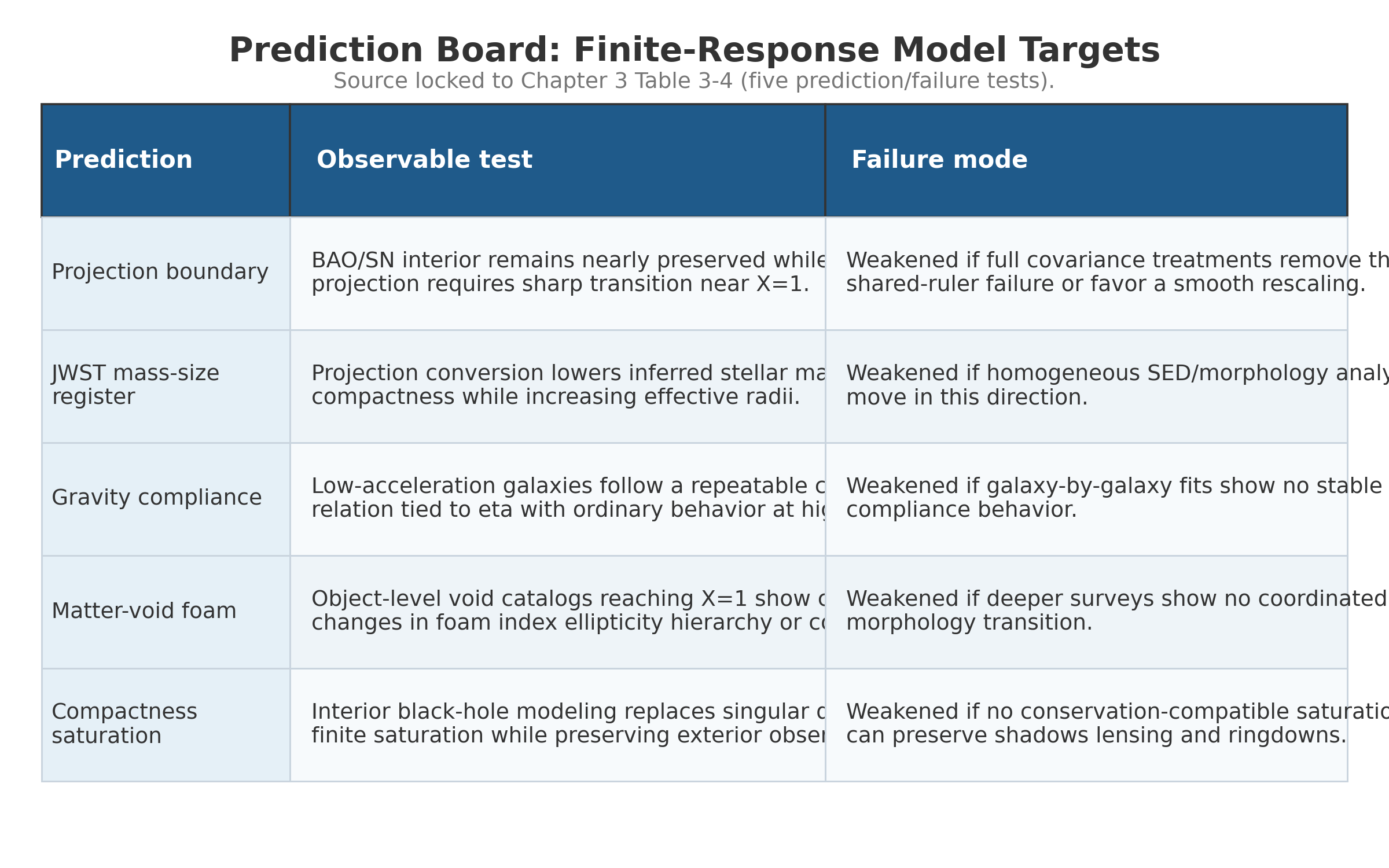
16. Predictions and Failure Tests
Table 3-5. Predictions and failure tests.
| Prediction | Observable Test | Failure Mode |
|---|---|---|
| Projection boundary | BAO/SN interior remains nearly preserved while CMB-side projection requires sharp transition near \(X=1\). | Falsified if full covariance treatments remove the shared-ruler failure or favor a smooth rescaling. |
| JWST mass-size register | Projection conversion lowers inferred stellar masses and compactness while increasing effective radii. | Falsified if homogeneous SED/morphology analyses do not move in this direction. |
| Gravity compliance | Low-acceleration galaxies follow a repeatable compliance relation tied to \(\eta\), with ordinary behavior at high \(\eta\). | Falsified if galaxy-by-galaxy fits show no stable compliance behavior. |
| Matter-void foam | Object-level void catalogs reaching \(X=1\) show coordinated changes in foam index, ellipticity, hierarchy, or connectivity. | Falsified if deeper surveys show no coordinated morphology transition. |
| Compactness saturation | Interior black-hole modeling replaces singular divergence with finite saturation while preserving exterior observables. | Falsified if no conservation-compatible saturation law can preserve shadows, lensing, and ringdowns. |
17. Current Model State and Future Verification
The current formulation specifies \(T, \Phi, C_g, S, G, D,\) the provisional register-scaling parameters \(K_D, K_X, K_\eta\), the trial compactness value \(K_u=1/3\), and the response map \(C(X, \eta, u, D_n)\) as coupled model components. The objective is a unified derivation and numerical implementation that links these components through conservation-compatible dynamics, including an explicit field-theory form for \(F_{\mu\nu}\) and a compactness interior law.
Future verification requires a unified numerical model containing \(X, T(X), \Phi, G, D, \eta, u, K_D, K_X, K_\eta, K_u, C_g,\) and \(S(u)\); homogeneous JWST mass-size conversion using consistent spectroscopy and morphology; deeper object-level void catalogs approaching \(X = 1\); SPARC galaxy-by-galaxy finite-compliance fitting; and a stronger compactness-sector test able to distinguish \(K_u=1/3\) from the \(K_u\sim0\) saturation-only case. These tests must also determine whether the K-values survive independent parametrizations or collapse as fit artifacts.
18. Conclusions
The finite deformable universe model unifies the empirical results and diagnostic screens into a finite geometric domain with several response registers.
The model centers on a finite geometric domain where projection depth, local gravitational compliance, matter-void foam shape, and compactness saturation serve as the primary registers.
Technical note
The normalized coordinate \(X = A/A_t\) keeps the model tied to the BAO-CMB recovery transition and prevents confusion among \(A, \chi,\) and the 0.390906 scale ratio.
Technical note
The path-response law \(A(d) = \int G(d) dd\) supplies the redshift engine; \(T(X)\) supplies the focal projection boundary; \(\Phi\) supplies the mass-size projection register.
The SPARC relation serves as a weak-field compliance target, while black holes are treated as compactness-saturation targets. The matter-void network is interpreted as a shape register of the geometry, with voids and web structures viewed as co-expressions of the same deformable domain.
The unified response function \(C(X, \eta, u, D_n)\) is the central model object. The fitted exponent triplet \(K_D \sim 1/2\), \(K_X \sim 1\), and \(K_\eta \sim 2/3\) is a provisional diagnostic attached to that object, while \(K_u=1/3\) is retained only as a compactness-sector trial value for the full cosmology.
This model defines a finite-domain picture that can be tested through projection-boundary behavior, JWST mass-size conversion, weak-field compliance, void-foam morphology, and compactness saturation.